Showing posts with label getaway. Show all posts

Saturday, September 4, 2010

Quebec City Episode

Québec City is one of the oldest cities of North America. Capital of Québec, the French province of Canada, this small city was built on the banks of Saint Lawrence River. This charismatic city has been declared as a World Heritage Centre.

Our trip to Québec province (Montréal and Québec City) was part of our South East Canadian Trip in May’10. We decided that it should be a road trip as we both enjoy driving around so much. Hence we hired a car at Toronto. The drive to Québec City was uneventful but not very picturesque. We noticed that sign boards written boldly in French as we entered the province. We knew the journey had almost ended that way. We reached Québec City late afternoon. We stayed at a quaint little hotel 10 minutes away from the old walled city.

One of the cobbled streets of Québec City
Most of the places of visit are within the walled city. So we decided to walk within for rest of the day. As one can imagine, parking is a big problem and is expensive within the walled city. The walled city is divided into upper village (Hauté Ville) and lower village (Bassé Ville). We walked around Hauté Ville all evening, admiring the narrow and cobbled streets, old-fashioned buildings. This place had such a European feel to it – so different from rest of Canada or even North America. We hopped on a couple of pubs and settled in a lovely Italian restaurant with live music for dinner (before you ask - we were reserving Québecois French food for the next day).

The next morning, we booked ourselves to a walking tour that we had heard so much about. We decided on taking the grand tour - What better way to see the old city! Our guide was a Quebecois (naturally) Professor who spoke good English. He had thorough knowledge about local history, an excellent sense of humor and patiently answered all questions. We were a group of 8 people in the tour. Since it was a walking tour, we didn’t go into any buildings. But the guide specified which ones were worth returning to. More details about the tour can be found here. After the tour, we had our lunch at a local favourite – a French café in 1 of the back alleys of Hauté Ville.

We then returned to the places that we wanted to re-visit, as per our walking tour guide:
  • Rue du Petit-Champlain - the main street in Bassé Ville for shopping, food & street performances.
  • Quebec City Mural – This is a five story three dimensional painting on the side of a building in Bassé Ville that displays a very successful trompe-l'oeil (to trick the eye) effect. It depicts several notable people in Quebec history
  • Sainte Anne de Beaupre Basilica in Hauté Ville
  • Funiclair - old time elevator between Hauté Ville and Bassé Ville
  • Le Château Frontenac - A palace in Hauté Ville overlooking Saint Lawrence River. It has been turned into a hotel & is owned by Fairmont (Surprise! Surprise!)
  • La Citadelle – The Royal 22e Régiment museum. We missed the changing of the guards (10:00 am daily in summer) as we went there in the evening.
But there is so much more to write about, to see around. We couldn’t cover all that we wanted to in the 2.5 days we were there (e.g., Museum of Civilization).

View of the walled city of Quebec from the Levis ferry
That evening, our 2nd in Québec City, we took the ferry to the other side of Saint Lawerence River – to Levis. Not that there is much to do in Levis, but the view of the walled city from Levis (or even the ferry) is breathtaking! Right next to the ferry docks at Levis, there is a micro-brewery called Corsaire Microbrasserie. We tried different types of beer (I think I counted 10 or 12) before we took the ferry back to the old city.

Our 3rd morning was spent driving around L' Île d'Orléans, an island formed in the middle of Saint Lawrence River. Though we didn’t go to any of the vineyards, wineries or museums, we drove around the whole island. We found the island to be a very quite and charming place with various small villages. We noticed that wind surfing and kite surfing were extremely popular off the island beaches.

Montmorency Falls
We then headed to Montmorency Falls. Its 11 kms (7 miles) from the walled city and on the way (back) from L' Île d'Orléans. The first thing one notices about Montmorency falls is its striking height - It is higher than the Niagara (one wouldn’t expect) and quite broad too (though not as much as Niagara or even American falls). There is a nice park around the waterfalls – with few walking trails that are good.

Hurons entertaining visitors at Wendake
The last stop around Québec City was Wendake is a reserved area (for native Indians from Huron tribe). A reconstructed Huron village called Onhouä Chetek8e (where 8 is pronounced as Oua - as in ‘wh’ of what) is the main attraction there. These natives are always dressed in native clothes and perform a dance to welcome people. They sell souvenirs, art & crafts made by the tribe. Guides explain their customs, tradition, trading practices. This place also has a restaurant serving native Indian food – but unfortunately we reached just after the restaurant closed.

Thus our 3 days in and around Québec City ended - totally overwhelmed by this old-world city and its surrounding areas. But we were also looking forward to our last leg our South East Canada TripMontréal

Montréal Fren(ch)zy

The Montréal comes from Mont-Royal – a hill located in the heart of the city. It was call Ville Marie (City of Mary) before that. Montréal is the 2nd largest city in Canada, after Toronto. This city is located on an island formed between Saint Lawrence River and Ottawa River.

Our Montréal visit was the third and final phase our South East Canadian Trip in May’10. Hiring a car at Toronto, we first drove to Québec City and then to Montréal before heading back. Though the journey from Québec City to Montréal is just 145 kms or 2 hrs away, we unpredictably got stuck in a traffic jam close to an hour if not more. It reminded us of good old Bangalore and its ways.

There is lot to do and see in Montréal depending on interests. Here is a list of what we covered:
Montréal Olympic Stadium
Biodome – On the lines of Eden Project in UK, Montréal’s biodome is divided into 4 ecosystems – each hosting flora and fauna specific to different climatic conditions – marine, temperate, tropic and polar. Since we had seen other biodomes, we weren’t thrilled with this one. The only highlight for us was seeing Penguins. They are as cute as they are portrayed in happy feet movie but it was an EXTREMELY pitiable situation for them.
Olympic Stadium – Montréal hosted the 1976 winter Olympics and one can visit this multi-purpose stadium. Nicknamed as the big O due to its shape and cost (o=owe), this is one of the sour-spots for localities.
St. Joseph's Oratory
St. Joseph's Oratory – Located in Mont Royal, this is the biggest Basilica in the province. We were surprised to see many visitors had come there on a pilgrimage. We quickly learnt that this Basilica was dedicated to Saint Joseph who was known for miracles and hence it is a pilgrim for believers of Saint Joseph’s healing powers.
Old Montréal – One can easily spend an entire day at the very least exploring old Montréal. Apart from various heritage buildings, old Montréal also has lovely museums, bars, restaurants, shops and other attractions like the Nortre-Dame Basilica, Place Jacques-Cartier, old port, etc. We chose a walking tour of old Montréal – though our guide wasn’t as good as the one we had in Quebec City, the tour was good enough to understand basic history and facts of the place.
Inside Notre-Dame Basilica
Notre-Dame Basilica – This Basilica is an illustration of Gothic Revival architecture. The magnificent exterior compliments the exquisite and intricate interiors. This place is known for weddings and funerals of Canadian celebrities. (E.g. Pop singer Celine Dion’s wedding)
Place Jacques-Cartier – Located in old Montréal, this is one of the most popular spots in the city having host of fine dining restaurants. During summer, you can see lot of street performances and people selling knick-knacks. Place Jacques-Cartier links old Montréal to the old port.
Inside the Cathédrale
Old Port – Once a flourishing port is now a park for different sports, recreation and artists. A very spirited place always filled with people (at least in summer). Quite often you find indi-bands playing around the park.
Cathédrale Marie-Reine-du-Monde – also known as Cathedral-Basilica of Mary, Queen of the World. This is a very beautiful Cathedral which is a replica of Saint Peters Basilica in Rome.
Montréal's Underground City (officially RÉSO or La Ville Souterraine in French) is the set of interconnected complexes underground in downtown Montréal. This underground city is so self sufficient that one doesn’t need to go out in the open in winters apart from catching the metro between home and here.
Cirque de Soliel – Originally from Montréal, cirque de soliel (Circus of the Sun) is an extravaganza of entertainment, aerobics, acrobatics and circus (without animals). A HIGHLY recommended show, even though it’s expensive (Weekdays are cheaper than weekends). Do ensure you book in advance though.
Circuit Gilles Villeneuve – This is the F1 circuit of Montréal – the reason for the city to practically shut-down in June/July every year to celebrate the yearly event. We got cheap thrills of driving around the circuit – unfortunately the speed limits (in non race times) is 30 kms per hour as people use this circuit for walking, running, skating, cycling etc.
Rue St. Laurent - is one of the most popular places for shopping restaurants, bars and night clubs. It is similar to Residency Road in Bangalore I suppose.
Mado Lamotte, drag queen
Rue St. Catherine – is on the lines of Rue St. Laurent. But most weekends (in summer), parts of this street becomes a ‘no-vehicles’ zone. We were pleasantly surprised to find a Latino festival when we visited this street with Flemenco dancers performing on one side and food/tourism stalls on another side. One end of this street is known as “the village” (for gays and lesbians). We landed up going for our first drag queen (wiki) show at Mado’s Cabaret. A unique experience for us – though we had lots of fun, we only wish that the show was completely in English so that we could enjoy all the jokes.
A bixi stand

We traveled around in local metro as always. The metro is very well connected both in downtown and suburban area. The connectivity is as good if not better than that of Vancouver. We were super thrilled to learn about the bixi (wiki) concept. Bixies (wiki) are public bicycle sharing system (like cycle rentals) in downtown & old Montréal.

Montréal is such a happening city that, one can never finish covering the city in just 3 days especially if interests are as varied as ours. Some of the local attractions we wanted but couldn’t explore were Jean Drapeau Park, Île Notre-Dame, Casino de Montréal, Mont Royal and Museum of Fine Arts. Here is a good but essential Montréal attractions list we found during our research.

A self-confessed food lover that I am, I was pleased to try various restaurants/Pubs/Bars around the city (and still didn’t get enough of it). Here is a gist -
La Sala Rossa: a Spanish Tapas bar at Rue St Laurent. We really enjoyed our Sangria as well as the tapas we ordered. [Tapas – are small quantities of food].
Jardin Nelson: This place is at Place Jacques-Cartier. Known not only for its excellent food but also for live jazz, this delightful place has garden seating as well as terrace seating.
Olive and Gurmando: a bakery and café on Rue St. Paul in Old Montréal. We found this local favorite absolutely cool.
Dunn’s – Montréal is known for its smoked meat and Dunn’s smoked meat sandwich is a local favorite since early 1900s. There are many outlets throughout the city but we went to the one in downtown. I must say I didn’t enjoy it much probably because I haven’t developed a taste for it.
Jimbo’s Pub/Comedy Works – For those who love standup comedy, this is a good place to go to – It was not only in English but was of good standard as well. It is located on Rue Bishop in downtown, right next to Habibi.
Gibeau Orange Julep - colloquially as OJ or The Big Orange, is a popular hang out for locals at Boulevard Décarie (especially to show off cars & bikes). The Julep (orange milkshake) is very refreshing.
Habibi – is a Lebanese restaurant on Rue Bishop in downtown, this place bustling with activity even at 2:00am. I had some excellent kebobs. The usual Sheesha and live music was also available.
Byblos – is in Mont Royal (ave.Laurier E/Le Plateau) serving some lip-smacking Persian/ Iranian food.
Montréal Bagels – Apart from smoked meat, Montréal is very famous for the Montréal style bagels. These bagels are usually hand made and baked in wood-fired ovens. We tried bagels sandwiches in one of the many bagel establishments scattered all over the city.

No wonder Montreal quickly became one of our preferred cities– perhaps second only to London which is our most favorite city (so far). For anyone travelling to Montréal, we would recommend 2-3 days at the very least to enjoy and explore the city. Montréal is a very cosmopolitan city we think. Even though it is in the French province of Canada, it is easy to travel around. We picked up a few French words here and there, but could easily manage just speaking English. Perhaps as Indians, people pardoned our French :)  

Friday, September 3, 2010

Niagara Experience

We visited Niagara as part of our South East Canada trip in May’10. It was on eve of Victoria Day – a long weekend in Canada. As most do, we drove from Toronto to Niagara. The drive itself wasn’t too long or tiresome. We reached Niagara just to find out that there were a gazillion people there – such a contrast to the quite Calgary we are so used to now. A long weekend doubled with the fact that it was beginning of summer made people want to travel, was the logical explanation to the crowd.

Our initial feeling of seeing Niagara was that of disappointment – contrast to the natural beauty we expected, this place seemed to be infested with casinos, restaurants, bars and shops. Whatever happened to the serene atmosphere and tranquility we wondered? The first sight of Niagara Falls was overshadowed by the commercialization of the place. It was a concrete jungle practically.

We dragged our feet towards the maid of the mist – a boat tour to the heart of the falls. We felt it was one of those tourist things we had to get over with; but boy we were glad that we did - It was such an enthralling experience. The cruise takes you almost to the heart of the falls – This is as close as you can get to the falls - with the spray of the falls triumphing over everything else. You really feel awfully humbled in nature’s glory. It is absolutely brilliant! But it’s almost impossible to take out your expensive camera (read DSLR) out in this spray/mist. But I do recommend everyone to go this tour irrespective of its cost.

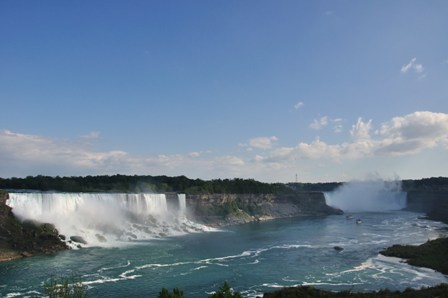
American Falls on the left and Niagara Falls far behind
Niagara has 2 HUGE waterfalls. One being Niagara falls and the other being the American falls. The American side has an observation deck which allows American visitors to look at the Niagara in addition to experiencing the American falls. American visitors can also take the maid of the mist cruise.

There are other attractions like journey behind the falls (a tunnel which takes you almost behind Niagara Falls), Sky Wheels (like London eye), Skylon tower (similar to CN tower). The rainbow bridge connects Canada and US borders. Children have a lot more to look forward to at Canadian Niagara, with a whole lot of attractions like wax museums of Hollywood stars, Ripley’s museum, arcades, etc.

The attractions are different from the US side. Access to Goat Island (island between the American Falls & Canadian Niagara falls) is on the US side. Prospect point takes you to the tip of the river where the rapids become American falls. This point also allows one to view Niagara Falls from the US side. We thought both the prospect point and the rainbow bridge were an eye sore amidst nature’s beauty.

But we spent rest of the day going to casinos and restaurants. Amidst all this, one of my dear Aunts visited us from Rochester, NY. Rochester is a few hours away in US, on the other side of the Canadian border. It was EXTREMELY sweet of her husband and her for this gesture as we couldn’t visit them since our Canadian Visa had expired. They visited us despite the crowd due to the long weekend. This is an exemplary illustration of family matters!!!

We returned to Toronto by road the next morning so that we could leave for the next phase of our South East Canada Trip – to Québec City and Montréal.

Toronto Stay

Canada’s largest city in terms of population and area, Toronto is built on the banks of Lake Ontario. 1 among the 5 great lakes of North America, Lake Ontario is so huge that you really can’t see the other side of the lake. It feels like a sea. Also it’s so big and deep that it doesn’t freeze even in Canadian winters. Naturally, Toronto’s downtown is set on harbor-front.

We visited Toronto as part of our South East Canada trip. It was always on our agenda of any North American travel, as much as Seattle. After all, we associated Toronto more with my dear Aunt & family than anything else. Understandably our main agenda was to spend time with family. But we also wanted cover the major tourist attractions. We knew that though it was our first, it wasn’t the last of our trips so we could afford to go slow, and take it easy.

As we prefer to do, we used the local metro and LRT extensively. Our verdict was that it wasn’t as good as in Vancouver or Singapore, forget London. But the metro is quite good within Toronto city limits and partly GTA (greater Toronto area).

Some of the local attractions we visited were:
CN Tower observation deck's glass floor
CN Tower: Once upon a time this was the tallest free standing structure in the world. When you think of Toronto sky-line CN tower stands tall and strong in the picture. This is a communications and a 360° observation tower and 1 of the main tourist attractions of Toronto. The view from the famous CN Tower over looking the harbor is delightful but one has to hope for a clear day for this. The observation deck also has a glass floor. Taking a picture of the ground far below while standing on it is a must-do.


Harbour Front
Harbor-front: The water front has been utilized to the fullest for the pleasure of visitors and citizens of Toronto. Shops, bars and restaurants are anyway a given in such a picturesque setting but harbor-front also boasts of a music garden (reflection in landscape of Bach’s music), boardwalks, skating rink and being epicenter of Toronto’s art & culture.

Old York: Also known as the old town flanks current downtown Toronto. It is home to a lot of landmarks such as St. Lawrence Market, St. James Cathedral, Oldest post office, etc.

Swaminarayan Temple
Swaminarayan Temple: This Hindu temple is worth a visit mainly due to the elaborate and intense architecture. People from as far as India were brought in for the sculpting work.

St. Lawrence Market: This market is in the heart of old York. A very vibrant place with lots of different types of shops (delis, bakeries, meat, food, knick-knacks, etc), it also hosts weekly farmers’ market and antiques market.


St. James Cathedral
St. James Cathedral Church: Part of downtown and close to St. Lawrence Market, this church is a good example of gothic revival architecture. Built in the 18th century, this church stands handsome adjacent to a beautiful park where pigeons and orchids are aplenty… in summer.

Toronto’s first post office: Apart from being a full-service post office, this is also a museum of Canadian postal history. As a tourist attraction, one can write a letter with a quail pen and seal them with wax just like the old times. Unfortunately this place was closed when we visited.
ROM
Steam Whistle Company: Situated bang opposite the CN tower in downtown Toronto, Steam Whistle is a microbrewery with an attitude! An environmentally conscious brewing company, Steam Whistle has indeed one of the best pilsners in Canada. This place has a brewery tour, samplers and great take away options, including a briefcase of beer – now beat that!

Royal Ontario Museum (ROM): Museum lovers should set aside AT LEAST a day for this. It is the largest museum in Canada and 1 of the largest in North America. It is a museum of anthropology. We spent an entire day and covered probably only half of the museum.

Though we couldn’t make it the following local attractions due to lack of time, it sure is on our TO-DO list for our next visit:
Toronto Islands: These islands are on Lake Ontario and in front of Toronto’s harbor. These numerous small islands has the city airport on 1 of the islands, a host of beaches, a children’s amusement park, a yatch club and is home to art, culture, flora & fauna.

Bata Shoe Museum: Yes, this is a shoe museum and which Indian would’ve imagined Bata to be a Canadian company! But of course, Bata is own by a Czech. This museum is situated very close to ROM.

Kensington Market: Is one of Canada’s national historic sites and is also a multicultural neighborhood of Toronto. It has variety of good restaurants, shops, galleries, discount stores, etc.

Some of the day trips or short trips one can take from Toronto are Niagara Falls, 1000 islands, Kingston and Ottawa – All are within 4-5 hours of driving. We could visit only Niagara Falls in this trip though. We also visited Québec City and Montréal.

I am certain that there are lots more to explore in and around Toronto which we may not be aware of as well. Also, though we did go to a couple of bars with my cousin, we didn’t get a chance to go on proper gourmet trips we so like to take. All in all, we thought we had fabulous family trip but we didn’t spend enough time in Toronto to feel its soul. So we’ll definitely be back.

South East Canada Trip

Ever since we reached Calgary or probably ever since it was decided we were coming to Calgary or probably ever since she moved to Canada, my aunt (theoretically my grand aunt) wanted me to visit her. She has been living in Toronto for more than 25 years. So we always knew that if not any other place, we would definitely visit her for sure. We’ve always heard of her family being great hosts and aunt being an awesome cook. So justifying that Niagara Falls is a close-by tourist place wasn’t really an incentive.

We decided to visit them in early summer of 2010 and cover Montréal and Québec City as well. Our final itinerary was: Calgary-Toronto-Niagara-Toronto-Québec City- Montréal-Toronto-Calgary. So our 11 day - 3 phase approach to most vacations was put into effect again.

The first phase was Toronto and Niagara.

Our Toronto stay was a mix of exploring the city, visiting local attractions and spending time with family. More information of our Toronto trip can be found here.

The Niagara experience was a mixed bag. On one side you see one of the natural wonder of the world. There are no words to express the grandeur of this geological beauty. On the other hand there is such a bad taste of commercialization. All around the falls you see a concrete jungle filled with restaurants, bars, pubs, hotels and casinos. More information of our Niagara experience is here.

Québec City was the second phase of our trip. The Québec City episode was heartwarming especially after the Niagara experience. This city not only has the historic value but also gives a very European touch be it through architecture, art or culture. We loved walking through the old walled city and exploring the surrounding areas as well. More information of our Québec City episode is here.

Our third and final phase was the Montréal Fren(ch)zy. It was the most fun and remarkable phase in the entire trip. We would easily rate this city second only to London – our most favorite city in the world (so far). We found this city to be pulsating. Be it walking around old Montréal or visiting local attractions or checking out various festivals (through out the year) or experiencing the foodie paradise or getting a sense of the night life… the list is endless. This city doesn’t sleep, there is something for everyone and it keeps you on a high (no pun intended) always. More information of our entertaining Montréal episode is here.

Monday, February 15, 2010

México Tenoctitlan

Did you know that this capital city is sinking at a rate of 3 inches a year? It has already sunk over 30 feet so far. The city was built over a lake centuries ago. Being 1 of the most populous cities of the world, increase in water consumption has led to major reduction in the city’s ground-water. The dry lake underneath has made this city sink. The Méxican Government has been pumping lots of money to preserve historic structures by injecting concrete into the foundation to increase their height. (http://www.wisegeek.com/is-mexico-city-really-sinking.htm) To add to this observable fact, the city has an active volcano as well as seismically active ground. It makes one wonder if the Mayan Apocalypse dated 23/Dec/2012 can ring true for México City. So believers of Mayan calendar – you don’t want to miss visiting this charming city before the predicted Catastrophe. There is so much of history, art and culture to see and experience.

We visited México for our 2009 year end vacations and spent 4 days in México City. This was our Phase 1 of our 3 phase trip. We really had to plan our Phase 1 well as we had to cram in as many things as possible.

México City was first the capital of the Aztec Empire. The story goes that Aztecs were originally nomads from Aslan (northern México). According to legend the Aztecs saw a vision from God who said that they have to go in search of the Promised Land, which they would recognize when they saw an eagle sitting on a Cactus with a snake in its mouth. Thus came into existence - México Tenoctitlan. (http://www.aztec-history.com/)


We travelled around México City by metro, buses, taxis and in our able guide – Islas’s car. There are beautiful monuments and ancient buildings through out the city having interesting anecdotes and historic significance. The main attraction is Centro Histrico, a historic square with many beautiful old buildings, which are well kept like the National Palace and 16th century cathedrals. Unfortunately during the Spanish conquest, most of the Aztecan buildings were demolished. So if one excavates in and around Centro Histrico, they are bound to find Aztecan ruins (they have excavated a part of Aztecan main temple – but it isn’t much). We visited the only surviving evidence of the Aztec empire – Xochimilco, a bunch of artificial islands built over swamps by the ancient Aztecs – a true engineering marvel.

We also visited the ancient city of Teotihuacan, just outside the city. This HUGE archeological site is known for the Pyramid of the Sun (3rd largest pyramid in the world) and Pyramid of the moon, large residential complexes, the Avenue of the Dead, and well-preserved murals. Dated back to 2BC, this ancient city’s ethnicity is still unclear. Since the site is dated much before Aztec era and this region is not part of the known Mayan empire, scholars have suggested possible rulers being Nahua, Totonac or Otomi. (http://whc.unesco.org/en/list/414)


We got to experience the rich Méxican art and culture. The city is adorned with many artistic installations and sculptures. A wonderful way to not only beautify the city but also encourage upcoming artists and show-off established ones. We got to see a game of Lucha Libre (original & more athletic version of American WWE), listen to the famous Mariachis (Méxican musical ensemble), catch a glimpse of local dance performances (Native Indian/ Spanish), and admire Diego Rivera paintings. We drove around the beautiful University, Olympic stadium, Azteca Football stadium (2nd largest in the world) and San Angel (a quaint art & craft street market).


We could also make a quick visit to the Museum of Anthropology – the 2nd largest museum in the world (after London’s British Museum) to check out the Aztec and Toltec section. This is an outstanding museum where people can easily spend 2 days minimum at least. We unfortunately had only 2 hrs to spare here. (http://www.mna.inah.gob.mx/muna/mna_ing/main.html)

Since we were in the city around Christmas, the streets were filled with locals partying every evening and we joined the celebrations with full gusto. We caught sight of the largest artificial Christmas tree in the world in full splendor - with charming Christmas lights adorning it. Méxicans love their food and drinks – its crux of all partying. So we tried a variety of them: Tamalés, tacos, tostadas, horchatas, jamicas, atolés, etc - the list is goes on. (http://en.wikipedia.org/wiki/Street_food#Mexico)

We liked this city mainly because of our guide, Islas Juréz, who ensured we experienced the pulse of the city and its culture. He is a highly knowledgeable, hard working, passionate Méxican and a thorough professional. He is the official guide for JW Marriot but then takes on private tours as well. He has a very comfortable Nissan which he uses for his guided tours. We would highly recommend Islas to anyone visiting this charming city.

We had landed in this city with a preconceived opinion of it being tourist unfriendly and extremely dangerous. But we left the city with quite a contrasting opinion. It made us feel that we should revisit this place.

Here is a link to our album:

Here is a link to a post summarizing our entire trip:

Saturday, January 30, 2010

Vamos México!

4 trips within India, 1 move (to Calgary), 3 trips after reaching Canada and 5 day trips to the Rockies – was the tally of trips we had taken so far in 2009. Deciding that it was enough for the year, we planned to stay put at home instead of the customary year-end vacation. Moreover Sharan had exhausted most of his vacation. When we revealed our grand plans of watching snow & cursing the weather, his colleagues quickly made us aware that with the number of Canadian public holidays around X’mas we could easily get a 2 week vacation by just taking a few days off. Thrilled with this news we instantaneously changed our decision and there was no looking back from there.

Consequentially the planning began. We knew we wanted to go a different country, especially one with rich in history, culture and nature. It was easy for us to narrow down to México. We started learning some basic Spanish words and sentences through an online tool. Simultaneously we narrowed down places of interest within México. We borrowed travel books and documentaries from the library. Internet searching was always there. So after some good research and advice from friends, we finalized our itinerary.

In phase 1 (24-28 Dec'09), we covered places in and around México City, the capital of México. We visited the ancient city of Teotihuacan, México City and Aztec's Xochimilco. We got to see the rich Mexican culture through Lucha Libre (original WWE), Mariachi (Mexican musical ensemble), local dance performances (native Indian /Spanish) & Diego Rivera paintings. We joined the Christmas celebrations, partying on the streets, eating lots of street food while looing at the tallest artificial X’mas tree in the world.

In phase 2 (28Dec09-1Jan10), we covered places around the Yucatan Peninsula (East México). We visited the ancient Mayan cities of Coba, Tulum, Ek Balam & Chichen Itza. We strolled around Playa Del Carmen, Cancun, Colonial town of Valladorid and the lovely fishing village of Puerto Morelos. We also tried fresh water snorkeling at some spectacular Cenotes.

In phase 3 (1-4 Jan'10), we covered places around Isla Cozumel, a lovely island off the Yucatan Peninsula. Isla Cozumel has the 2nd biggest coral reef in the world but parts of it have been destroyed by Hurricane Wilma in 2006. Unlike phase1 & 2, we just chilled out here except for an exciting scuba diving stint.
Link to the Picasa album:

Some of our best moments were (in no particular order):


  • Visiting Xochimilco: Artificial islands built over swamps by the ancient Aztecs. A true engineering marvel.

  • Seeing an active volcano: It came with some folklore, making it quite enchanting.

  • Marveling works of Mexican artists like Diego Rivera, Frida Kahlo, Sebastian – they were simply stunning.

  • Watching Lucha Libre: Never knew that WWE originated from this sport in México. Though not our favorite sport, it was great watching the locals passionately scream and cheer.

  • Driving around the Yucatan country-side: The roads were fine in the Yucatan Peninsula. We got to see some beautiful villages and towns like Piste, Puerto Morelos and Valladolid.


    • Snorkeling in the Cenotes: These limestone sinkholes holding ground water, is truly distinctive to this region. Seeing the limestone rock formations under water and play of light on them through water is indeed remarkable.


    • Gorging on REAL Méxican food – Totally different from its likes in India and even UK/ Canada (at least places we’ve tried). We couldn’t have enough of Tacos, Tamales, Moles and the spicy salsas.

      • We tried salsa made with 1 of the world’s spiciest chilies called the Habanera – the salsa was done well, so we could guzzle it down with local beer

      • I ate a unique dish called Mole Pablano – chicken with chocolate sauce. The sauce was definitely not sweet and easily became 1 of my favorite Méxican dishes.

      • We sampled Tacos made with blue corn tortillas. I didn’t even know there was blue corn…

      • We tasted cactus – now that was another new one for us. It is similar to green peppers/capsicum but with more flavor to it.

    • Trying different variations of Tequila: The anejos, mescals, resposado and blanco

    • Guzzling down chilled Cerveza (beer) in the warm weather: Montejo, Sol, Pacifico, Dos XX (Dos Equis), Victoria, Bohemia (best) and of course, the over-rated Corona.

    • Climbing various Mayan Pyramids – The magnificent views of the forests were totally worth the effort. Felt like a movie set – from Raiders of the lost Arc or something similar

    • Visiting 1 of the 7 wonders of the world – The ancient Mayan city of Chichen Itza was very intriguing.

    • Loafing around the Caribbean beaches – The sun, sand and water was just perfect to bum around. We alternated bum time between water, hammocks and photographing.


    • Scuba diving in the coral reefs of Isla Cozumel – It couldn’t get better than this.
    So what started off as a potentially cold and quite year end holiday, ended up being one of the most exhilarating holidays we’ve ever taken. Vamos México!

    Tuesday, December 22, 2009

    Grassi Lakes Hike (Canmore, AB)

    It was a while since we had visited the mountains, which we seem to have fallen in love with since we first saw them back in Aug’09. We had seen the Rockies a few times in summer and in fall. We loved it each time. Winter was just about setting in and we wanted to check how the Rockies looked in snow. More importantly we had just invested in our snow boots and wanted to try them out to ensure we made a sensible spend. So we chose to go on a hike to Grassi Lakes - just off Canmore.

    So we set on the morning of 22/Nov/09, a Sunday. We decided to leave early and have breakfast in Canmore town – we anyways had to go to the visitor’s information centre to confirm that the trail is still open after a heavy snowfall during the week. We didn’t get enough time the previous day to research on a restaurant, so we ended up walking down the main streets of Canmore in the cold before settling on a Coffee Shop specializing in Bagels. We gulped down the hot coffee and bagel sandwiches quickly. The information centre was closed, so we went to another centre in the outskirts. We got a confirmation on the trail and the helpful lady behind the desk gave us a couple of maps as well.

    As we approached the base, we saw how well winter had set in the mountains. Snow was allover and the lake at the base was already frozen. There are 2 trails to Grassi Lakes which is found around 200 meters from the car park. We had read and were also told at the information centre that the more difficult route had all the views - of Canmore and the Bow Valley. The more difficult route is not really very difficult but one has to watch their footing. Though there is a series of stairs to make the climb easier, the snow and ice made the path extremely slippery. Moreover it had completely covered the path in many places and we were clueless on where to go next. We were lost for about an hour with no signals on the phone as well. At one point we contemplated on retracing our steps. But we got stuck in a particularly difficult spot.

    The spot was difficult because a brook running down the mountain had frozen and the whole place was just ice. We fell several times between the 2 of us. The situation was more hilarious than we thought – am sure we looked like bowling pins getting knocked down regularly. We managed to catch a glimpse of a lovely and quite big waterfall over the next mountain amidst our falling act. Luckily an hour into this falling and searching madness, a group of hikers came along. One of them had been to the place before so knew the “hidden” path. We followed them all the way to the top.
    There are 2 lakes (springs really) at the top and a beautiful view of Ha Ling Peak. The 2 lakes atop the mountain have been named after the guy who discovered it. The lakes themselves are a sparkling sight. The water is so clear that a good reflection of the mountains, tree and snow falls very well on it. A steep but short climb at the end of the upper lakes leads to a canyon where a genuine petro-glyph can be found on a large boulder. We heard that the area was popular sport climbing as well. We didn’t climb that part as it was getting late – we had lost a lot of time earlier on trying to find the path to the lakes. But it gives enough inspiration for a re-visit at least. We got back on the easy route after the interesting incident we had on the other route. This route was quite boring comparatively. It looked like a truck route and just cut through the trees blindly.

    We were thankful to come back home and that too in one piece. But despite the episode we loved the hike – it was enchanting and charming nonetheless.


    More information on how to access the trail and the trail itself can be found at:

    Monday, November 23, 2009

    Bow Pass and Mistaya Canyon

    JJ wanted to go the mountains for the last time as a Calgarian and before he relocated back to London. JJ, Anne and we set out on a Sunday morning (18/Oct/09) having a quick Cafe Beano's coffee. It had just started snowing in the mountains. So we could see the snow capped mountains. But it hadn’t yet snowed enough for the Skiing season to begin. The tracks hardly had any snow.

    We first went to Bow Summit which is a viewpoint for Peyto Lake and glacier. It’s on the Icefields parkway road within Banff National Park - around 30 minutes from Lake Louise. We drove up to the Bow Pass/Summit. The lookout point is a short trail from the parking lot. The path was icy and slippery. Sharan and I didn’t have shoes which could be used on this terrain. JJ being the English gentleman that he is, very kindly offered to help me walk. Sharan was on his own with his Camera. The viewpoint is that of Peyto Lake and Glacier. The lake is turquoise blue and shaped like a dog (or that’s what it looked like to us). It was stunning. We could also see the half melted glacier which forms the source of this lake. We hear it in the news and read it elsewhere but really the affects of global warming is clearly seen around these areas with glaciers melting. The lake is surrounded by lush coniferous forests. Behind the forest are the Rocky Mountains. The place looked absolutely enchanting. As we hung around having hot “Chai” (tea) brought by JJ in a thermos, it started to snow. So we quickly drank up and left for our next destination - Mistaya Canyon


    Mistaya Canyon is also on the same highway as Bow Pass. But it’s further up and took us another 30 minutes to drive to that place. A trail off the highway led us to the Canyon. One cannot miss it as it is well sign-posted. Along the trail we saw the wrath of storm that lashed this region last year. Trees were uprooted and ripped apart. Mistaya Canyon is formed by the Mistaya River whose source is a glacier around Peyto Lake. The white water of Mistaya River roared down the Canyon and a spray of water surrounded the place. The Canyon was really deep and one could easily notice the path the river had taken, eroding and curving the rocks along the way. We hung around the place for a while enjoying views of this boisterous river in a tranquil background before heading back home.

    We had seen the mountains in summer and fall. It was our first time in the mountains after it had snowed. The 2 places were exquisite in their own way and nothing like what we had seen before. I suppose it was a good day for JJ - to say goodbye to the mountains. I guess he’ll miss the proximity of the mountains the most for he'd be back for the skiing season(s) but that's a different matter.